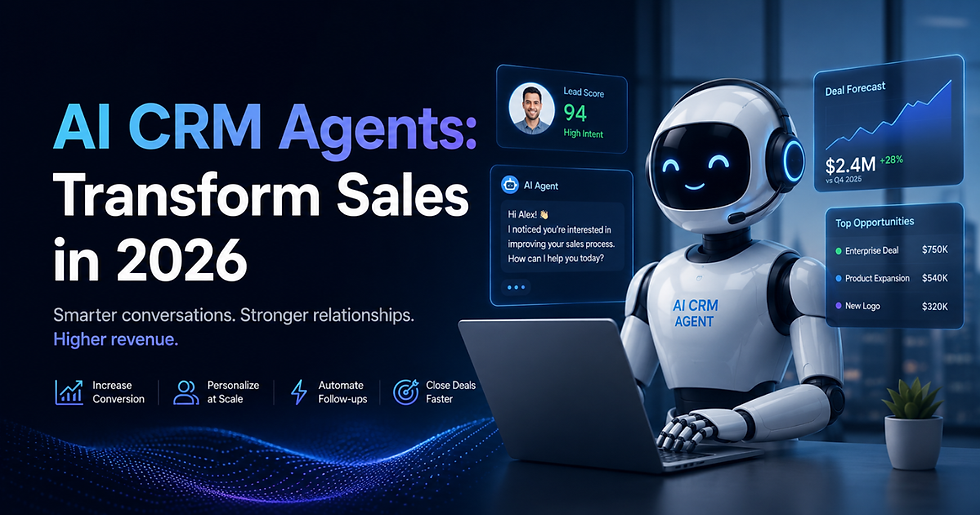
AI CRM Agents: Transform Sales in 2026
- bhartiig6
- May 12
- 9 min read
The traditional sales workflow is obsolete. Your sales team is drowning in administrative tasks—manually entering data into your CRM, scoring leads by gut instinct, following up with prospects at random intervals, and generating reports that tell yesterday's story instead of tomorrow's opportunity.
The Reality: According to Gartner's 2025 CRM adoption study, 58% of CRM implementations fail to deliver expected ROI within 18 months. The primary reason? Organizations implement technology without fundamentally reimagining how their teams work. They simply automate existing broken processes.
AI CRM Agents Change Everything
Unlike traditional CRM systems that passively store data, AI CRM agents are intelligent, autonomous systems that actively manage your entire customer lifecycle—from lead qualification through customer expansion. They learn from your sales patterns, adapt to your market conditions, and make autonomous decisions that would normally require hours of human analysis.
This isn't science fiction. Microsoft, Salesforce, and HubSpot have invested billions in agentic CRM capabilities. Across enterprise organizations, early AI CRM adopters are reporting 35-50% improvements in sales productivity, 25% faster sales cycles, and 18% higher win rates within the first year.
68% of Fortune 500 companies projected to have AI CRM by end of 2026
By 2026, AI CRM agents won't be a competitive advantage—they'll be table stakes. Organizations without them will struggle to compete against enterprises equipped with 24/7 autonomous AI sales execution.
This comprehensive guide reveals exactly how AI-powered CRM software is transforming customer management, what autonomous CRM adoption looks like in practice, and the real ROI you can expect from intelligent sales automation systems.
AI CRM Agents: A New Category of Enterprise Sales Technology
The Fundamental Shift: From CRM Databases to Systems of Action
For 20 years, CRM development meant the same thing: a database. You entered customer information, reported on it, and manually executed on insights. The data sat there—valuable but inert. Your sales team was the engine; the CRM was just the fuel tank.
AI CRM agents invert this model entirely.
An AI CRM agent is an autonomous software system that continuously monitors customer data, identifies patterns, predicts outcomes, and takes action—without waiting for human instruction. It qualifies leads while your team sleeps. It identifies at-risk customers before churn happens. It recommends the next conversation your team should have based on predictive analytics.
Key Distinction: Traditional CRM automation follows explicit rules. "If customer hasn't been contacted in 30 days, create a task." Modern AI CRM development services learn and implicit patterns. "Based on 50,000 historical interactions, this customer profile has a 73% probability of churning if not contacted in the next 5 days, and the optimal contact time is Tuesday at 2 PM based on their previous engagement patterns."
How AI CRM Agents Actually Work
Data Integration & Enrichment — Automatically ingest data from email, calendar, communication platforms, website activity, and intent signals. Enrich customer profiles with third-party data. Validate and deduplicate records in real-time.
Machine Learning Pattern Recognition — Analyze historical sales cycles to identify winning patterns. Model customer behavior across touchpoints. Build predictive models for outcomes.
Autonomous Decision-Making — Score and rank leads based on AI analysis. Assign opportunities to optimal sales reps. Recommend next actions with confidence scores.
Conversational AI Interface — Sales reps interact with AI via natural language. Customer-facing chatbots handle common inquiries. AI explains its reasoning.
Continuous Learning & Adaptation — Models improve as new outcomes occur. AI learns your sales team's strengths. Predictive accuracy increases over time.
Enterprise AI CRM vs. Traditional CRM
Capability | Traditional CRM | AI CRM Agents | Impact |
Lead qualification | Manual review (4-8 hrs/week) | Automated in 2 seconds | 40-50 leads/day instead of 5-10 |
Data entry | Manual (5-8 hrs/week) | Auto-populated | $50K-$150K/year saved per rep |
Follow-up management | Calendar-based | AI predicts optimal timing | 15-25% higher response rates |
Sales forecasting | Manual + spreadsheets | Real-time predictive | 40% forecast accuracy improvement |
Churn identification | Reactive (customer upset) | Predictive (30-90 days early) | 12-18% reduction in churn |
Key Features of AI CRM Agents: Technical Capabilities That Drive Revenue
1. Autonomous Lead Qualification & Scoring
Traditional lead scoring is ineffective. You create a formula: "Website visit = 10 points, email open = 5 points." Then your sales team ignores it because they know better from experience.
AI lead qualification learns from what actually happens.
The system analyzes 50,000 historical leads across your company. It identifies that leads from companies with $50M-$500M revenue, in specific industries, who visit pricing pages within 24 hours have a 62% conversion probability. Meanwhile, leads that just filled out a form have a 12% conversion probability.
340%
Increase in qualified pipeline (no increase in total leads)
2. Predictive CRM Analytics: Forecasting Tomorrow's Outcomes
Static CRM dashboards show what happened yesterday. Predictive CRM analytics show what will happen tomorrow.
An AI CRM agent continuously models which of your 500 existing customers are most likely to cancel, which have highest propensity to buy adjacent products, and which opportunities need intervention to close this quarter.
Modern enterprises deploy these models with 75-85% accuracy, compared to 35-45% for manual forecasting.
3. Intelligent Sales Automation Workflows
Traditional CRM workflow automation is static. Intelligent CRM automation is context-aware and learns:
Dynamic task assignment: AI assigns to the rep with highest probability of closing this deal type
Adaptive follow-up cadences: AI determines optimal timing based on prospect's industry and behavior
Conditional automation: Smart triggers that adapt to business changes
Cross-team collaboration: Automatically coordinate between sales, success, and product teams
4. Conversational CRM: Natural Language Interface
Sales reps shouldn't have to navigate 15 menus to get an answer.
Conversational interfaces enable natural queries like:
"Show me high-value deals at risk of slipping to next quarter"
"What's the best time to contact this prospect?"
"Draft a personalized outreach email for this account"
85-95%
Adoption rate within 60 days (vs. 40-50% for dashboard CRM)
5. AI-Driven Customer Segmentation & Personalization
Most CRM segmentation is static: "All customers in the Finance industry." AI-driven segmentation creates dynamic, behavioral segments that update in real-time.
This enables extreme personalization at scale: each rep gets a custom view, each customer receives recommended content, each opportunity gets a tailored follow-up cadence.
Real-World AI CRM Proven Cases
SaaS & Enterprise Software Companies
The Challenge: Complex sales cycles (90-180 days), high CAC, intense competition, critical churn problem (5-10% monthly typical)
AI CRM Impact:
62 days
Average deal cycle (down from 95 days, -35%)
Additional metrics from a $50M ARR SaaS implementation:
✅ Win rate improved from 28% to 36% (+28%)
✅ Customer churn reduced from 7.2% to 5.8% (-19%)
✅ Net revenue retention improved from 112% to 134% (+19%)
✅ Sales productivity increased 42% per rep
✅ Annual impact: $20M incremental revenue
Financial Services
The Challenge: Highly regulated, complex compliance requirements, long account-opening processes (30-60 days), relationship-based selling
AI CRM Solution: Intelligent lead qualification with audit trail, regulatory-safe automation, fraud detection, relationship mapping
38%
Account opening time reduction (45 days → 28 days)
Additional metrics from a major U.S. bank:
✅ Compliance improved (zero audit findings related to AI)
✅ Fraud detection improved 45%
✅ Advisor productivity increased 28%
✅ Customer satisfaction improved 12 points
E-Commerce & Retail
The Challenge: High volume, short decision windows, inventory-driven promotions, customer service scale
AI CRM Solution: Conversational commerce chatbots, real-time personalization, churn prevention, inventory optimization
42%
Customer service cost reduction (from AI chatbots)
Additional metrics from a $200M e-commerce brand:
✅ Conversion rate increased 16% (AI recommendations)
✅ Average order value increased 22% (smart cross-sells)
✅ Customer retention improved 14%
✅ Annual impact: $30M (cost savings + incremental revenue)
Cost & ROI Analysis: The Financial Picture
Implementation Cost Breakdown (100-user team)
Cost Category | Traditional CRM | AI CRM Agents | Difference |
Software Licensing (Year 1) | $30K-$50K | $70K-$120K | +133% |
Implementation Services | $105K-$270K | $210K-$570K | +100% |
Training & Change Management | $16K-$43K | $35K-$90K | +50-100% |
TOTAL YEAR 1 | $151K-$363K | $315K-$780K | +108% |
Realistic ROI Model (Median Implementations)
Component | Value |
Year 1 Investment | -$550K |
Productivity Gains (28% per rep) | +$450K |
Deal Cycle Acceleration (22% faster) | +$620K |
Churn Reduction (5% improvement) | +$310K |
NET YEAR 1 IMPACT | +$830K |
ROI | 151% |
Hidden Costs to Budget For

Data cleanup: Existing CRM data is typically 30-50% inaccurate. Budget $30K-$100K.
Legacy system integration: If you have 5+ systems, integration is complex. Budget $50K-$150K.
Model retraining: AI models need quarterly retraining as business changes. Budget $15K-$30K/quarter.
Change management delays: Plan for 3-6 month ramp; budget for 10-20% productivity dip.
Compliance & security review: Budget $20K-$50K for external audits.
AI CRM vs. Traditional CRM vs. Platform-Specific Solutions
Complete Platform Comparison
Capability | Traditional CRM | AI CRM Agents | Salesforce + Einstein | HubSpot + AI Hub |
Lead Qualification | Manual | Autonomous ML | Excellent | Good |
Predictive Churn | None | 75-85% accuracy | Strong | Basic |
Conversational Interface | No | Yes | Emerging | Emerging |
Implementation Time | 4-8 weeks | 12-16 weeks | 8-12 weeks | 4-6 weeks |
Total Year 1 Cost | $151K-$363K | $315K-$780K | $200K-$500K | $120K-$250K |
Annual per-user cost | $150-$300 | $400-$600 | $300-$500 | $250-$400 |
When to Choose Each Approach
Choose Traditional CRM if: Budget constraints, simple sales process, need quick deployment (4 weeks)
Choose AI CRM Agents if: Complex sales cycles (90+ days), high-value deals, customer success critical, need AI-assisted insights
Choose HubSpot + AI if: Growing SaaS company, want managed AI, need quick deployment (6-8 weeks)
Choose Salesforce + Einstein if: Already invested in Salesforce, enterprise budget, require extensive customization
Legal, Security & Compliance: The Critical Enterprise Considerations
Data Privacy & Regulatory Compliance
GDPR Compliance (EU customers): AI CRM agents must process customer data only for stated purposes. Ensure vendor provides data residency options.
CCPA Compliance (California): Customers must be notified if data is used for AI training. Implement consent management layer.
HIPAA Compliance (Healthcare): Patient data must be de-identified. Vendor must sign BAA. Deploy on-premise or demand dedicated infrastructure.
FINRA Compliance (Financial Services): Every recommendation must be explainable and defensible. Implement decision logging.
AI-Specific Security Concerns
Model Bias & Fairness: Audit training data for bias; test model fairness; monitor predictions by demographic group
Prompt Injection Attacks: Implement input validation; limit AI context window
Data Poisoning: Use data validation rules; anomaly detection on inputs; regular model audits
Explainability: Require vendors to explain every material decision; implement audit logging
Enterprise Security Controls
Essential security features to demand:
✅ End-to-end encryption (in transit and at rest)
✅ Role-based access control (RBAC)
✅ Complete audit logging
✅ SOC 2 Type II certification
✅ ISO 27001 certification
✅ Annual penetration testing
✅ 24-hour breach notification
✅ Data residency options
✅ Multi-factor authentication (MFA)
Contract Negotiation Tip: Insist on seeing vendor's SOC 2 Type II report before signing. This is non-negotiable for enterprise deployments.
Industry Report: The 2026 AI CRM Market
Global AI CRM Market Growth:
2024 market size: $8.2 billion
2025 projected: $11.4 billion (+39% growth)
2026 projected: $15.8 billion (+38% growth)
CAGR 2024-2026: 38.5%
Enterprise Adoption Trends
Segment | 2025 Adoption | 2026 Projected | Change |
Fortune 500 | 35% | 68% | +33 points |
Fortune 1000 | 28% | 52% | +24 points |
Mid-market | 18% | 42% | +24 points |
Small business | 4% | 12% | +8 points |
Business Impact Statistics
Metric | Traditional CRM | With AI CRM | Improvement |
Sales productivity per rep | 100% | 140% | +40% |
Sales forecast accuracy | 43% | 78% | +35 points |
Customer retention | 92% | 95% | +3 points |
Win rate | 26% | 33% | +7 points |
Sales cycle duration | 90 days | 63 days | -27 days (-30%) |
Why Implementations Fail
Understanding failure reasons helps you succeed:
58%: Poor data quality (garbage in, garbage out)
42%: Inadequate change management (sales team resistance)
35%: Integration complexity with legacy systems
28%: Over-automation (team feels disempowered)
25%: Insufficient training
Lesson: Success requires equal investment in people, process, and technology. Technology alone will fail.
Final Thoughts
The CRM landscape is undergoing one of the biggest transformations in enterprise technology history. AI CRM agents are no longer futuristic concepts—they are becoming essential tools for organizations looking to scale operations, improve customer experiences, and increase revenue efficiency.
Traditional CRM systems focused primarily on storing customer information. Modern autonomous CRM platforms are built to think, predict, automate, and act. From intelligent sales automation and predictive CRM analytics to conversational CRM and AI-driven customer management, businesses are entering a new era of operational intelligence.

Organizations that invest in AI-powered CRM software today will gain a major competitive advantage in the coming years. Faster decision-making, automated workflows, enhanced personalization, and improved forecasting are redefining how enterprises manage customer relationships.
However, successful implementation requires more than technology adoption. Businesses need scalable architecture, strong compliance frameworks, AI governance strategies, and industry-specific customization. This is why partnering with an experienced CRM development company is critical for long-term success.
If your organization is planning to modernize its customer operations, investing in advanced CRM development solutions can help future-proof your business while maximizing ROI in the age of AI-driven enterprise transformation.
FAQ's
Why are enterprises shifting toward autonomous CRM systems?
Businesses are adopting autonomous CRM platforms to automate repetitive operations, improve forecasting accuracy, and accelerate customer response times. This shift helps companies scale faster with lower operational costs.
Can AI-powered CRM software really improve sales performance?
Yes, AI-powered CRM software improves lead qualification, follow-ups, and customer targeting through intelligent sales automation. Many enterprises report higher conversions and shorter sales cycles after implementation.
Is AI CRM software better than traditional CRM platforms?
Traditional CRM systems mainly store customer data, while AI CRM agents actively automate workflows and generate predictive insights. This makes autonomous CRM significantly more efficient for modern enterprises.
How secure are AI CRM agents for enterprise businesses?
Enterprise AI CRM platforms use advanced security frameworks like GDPR, SOC 2, HIPAA, and ISO 27001 to protect customer data. Proper AI governance also reduces compliance and privacy risks.
What industries benefit the most from AI CRM agents?
Industries like healthcare, fintech, SaaS, e-commerce, and real estate benefit heavily from AI-driven customer management and workflow automation. AI CRM systems improve operational speed and customer retention across sectors.
How much does AI CRM development cost in 2026?
Basic AI-powered CRM software may start around $15,000, while advanced autonomous CRM systems can exceed $100,000 depending on complexity and integrations. Pricing also depends on AI capabilities and compliance requirements.
What is conversational CRM and why is it important?
Conversational CRM uses AI chatbots and voice assistants to automate customer communication in real time. It improves engagement, reduces support delays, and enhances customer experience.
What makes custom AI CRM development better than SaaS CRM tools?
Custom AI CRM development offers better scalability, workflow flexibility, data ownership, and deeper AI integration. Businesses can tailor the system according to their exact operational requirements.
Why is CRM automation becoming essential for modern businesses?
CRM automation reduces manual operations, improves response times, and increases operational efficiency across departments. Companies using automation can scale customer engagement much faster.
How do I choose the right CRM development company?
Look for a CRM development company with expertise in AI, enterprise integrations, compliance frameworks, and scalable architecture. Industry-specific experience is also important for long-term success.
Comments